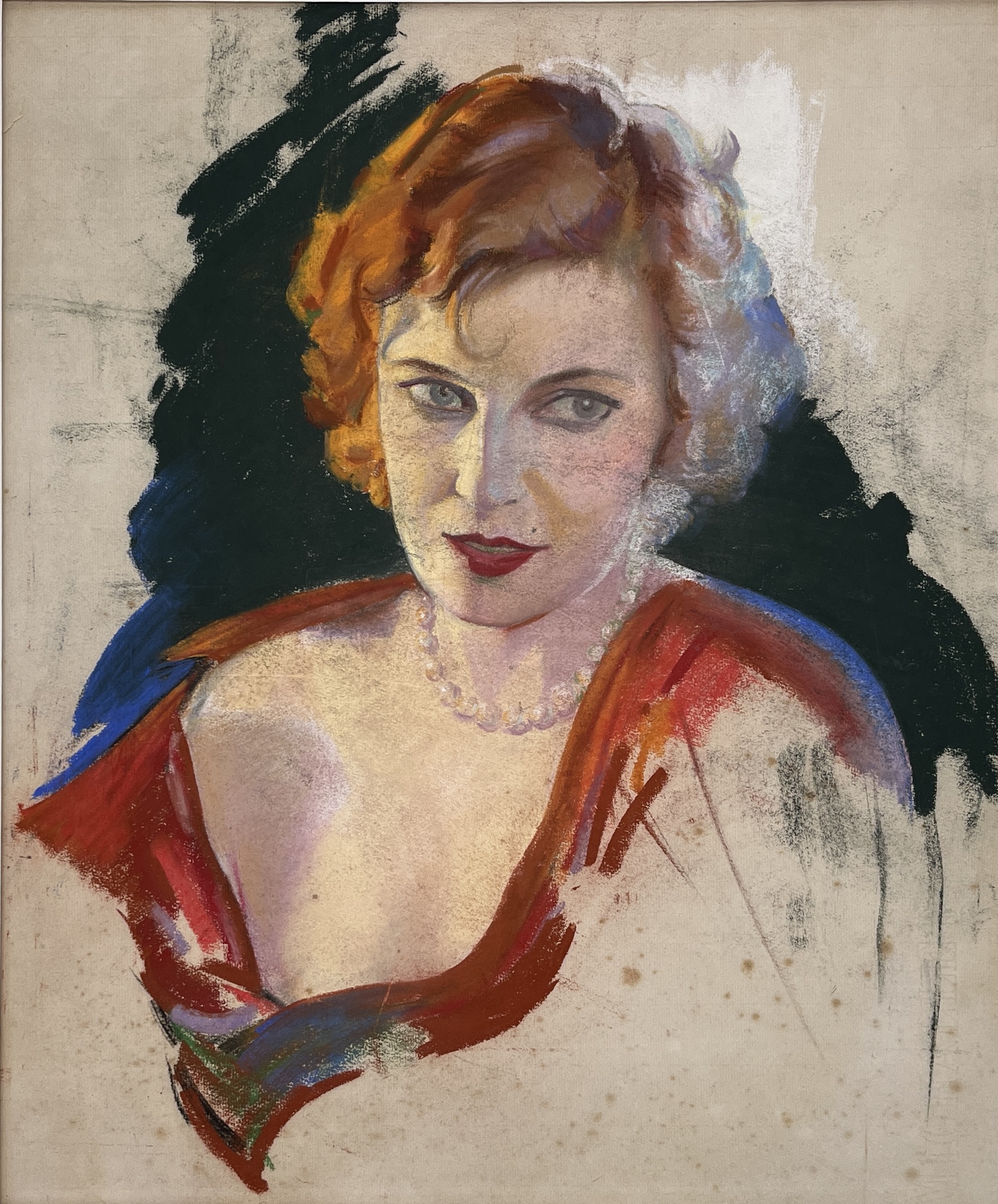
Olga Baclanova. Pastel on paper, 30 x 25 inches. 192
Even in his twenties, pastel played a role in Ben Solowey’s art and led to some of his best-known work.
After returning from a five-month sojourn in Europe in the fall of 1924, Ben Solowey supported himself in Philadelphia as a decorative painter recreating Old Master still lifes and game paintings for interior decorators and furniture stores, while continuing to show his own award-winning work in exhibitions around the city. When he left for New York four years later, he also left behind his decorative work. New York had fourteen daily newspapers, and all of them featured drawings as they were easier to reproduce than photographs, particularly in the Drama sections of the papers, which included many drawings of performers who were to open on shows on Broadway, in movie theaters, or perform on a concert stage. With his affinity for portraiture, Ben Solowey decided he would become a newspaper contributor.
Despite having no connections, Ben was undeterred from approaching editors of The New York Herald Tribune, The New York Times and other papers with an example of his work. He could have chosen to show his remarkable charcoal portrait of a cleaning woman from the Pennsylvania Academy of the Fine Arts that had won him the Ramborger Prize at the school and was featured in the school’s catalogue. Instead, he created a stunning pastel portrait of the Russian born actress Olga Baclanova from a black and white photo he found of her, presumably in a movie magazine at the time.
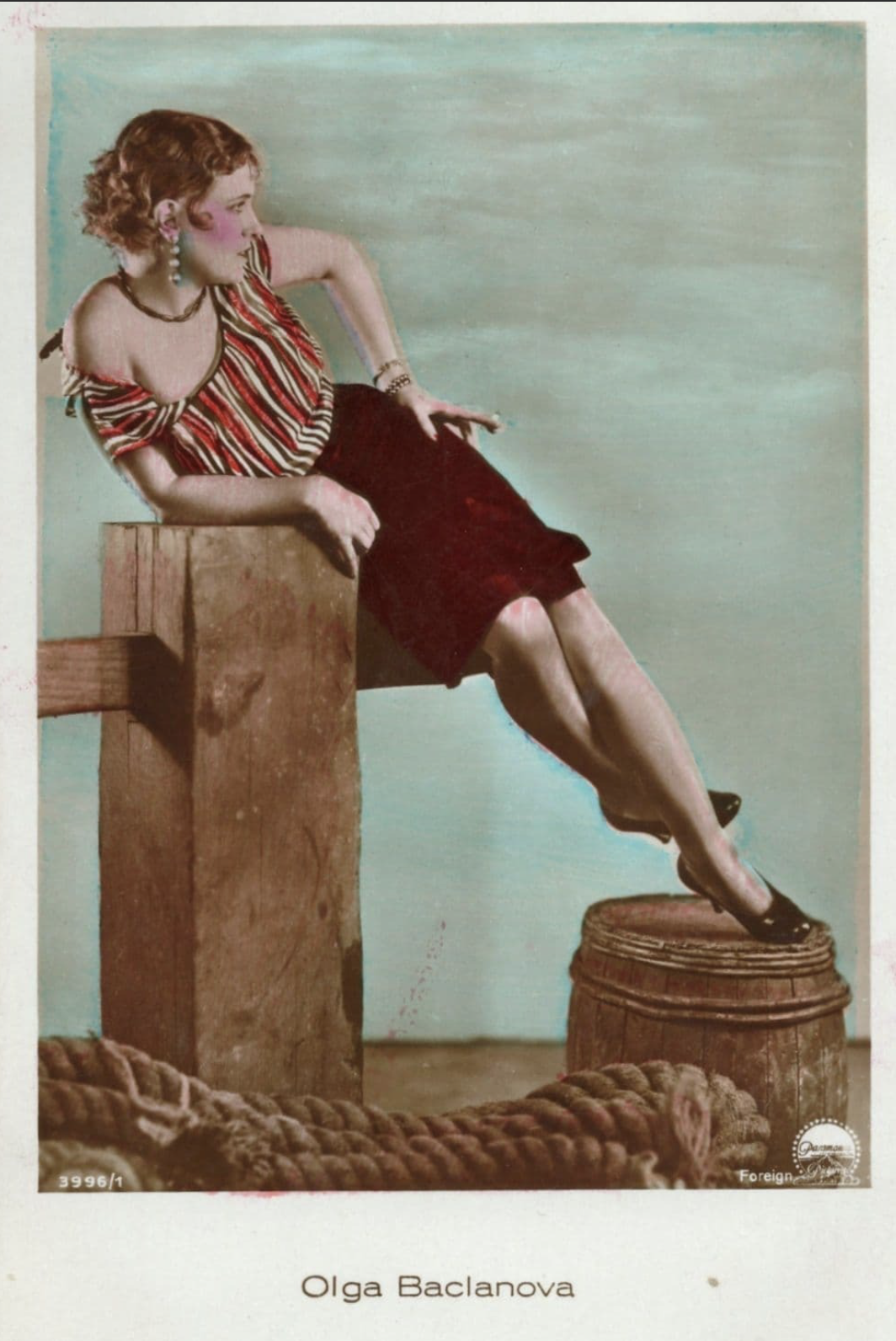
Olga Baclanova. Hand colored photo postcard. c. 1928
Baclanova was born in Russia in the late 1800s and as a teenager was accepted into the Moscow Art Theatre (M.A.T), an invitation, according to some reports, that came Konstantin Stanislavski himself. She had significant roles in plays by Ibsen, Chekhov and Turgenev, and M.A.T productions of Shakespeare and Dickens. She also starred in Russian films, and by 1925 she was named a “Merited Artist of the Republic”, the highest Soviet artist honor.
After touring America in 1925 in a M.A.T. production of Lysistrata, she remained in America when the troupe returned home. She appeared on stage in southern California before soon finding work in Hollywood silent films. By 1928, Baclanova was at the height of her fame. She appeared in seven feature films (and two shorts) that year, including the now classic The Man Who Laughs. Judging by film stills, Ben may have used one from the 1928 film, The Docks of New York, as a visual reference for his portrait.

Olga Baclanova in The Docks of New York. 1928. Directed by Josef von Sternberg.
If Baclanova is known at all today, it is because in 1932 she starred as the scheming trapeze artist Cleopatra in Tod Browning’s unsettling film Freaks. Her film career began to slow after that, and while she did perform on Broadway, most notably in the hit Claudia in 1941 as Madame Daruschka (a role she would reprise in the film adaptation two years later), she would slowly disappear from the world of the performing arts. She died in Switzerland in 1974.
This portrait, which has never been published, was distinctive enough that editors began to give Ben assignments for performer portraits. Ben’s “Theatre Portraits” (as he called them) began to appear in January 1929, the start of 12 year career in which he drew close to 900 charcoal portraits for New York newspapers, almost all from life. As vivid as this colorful pastel portrait is, either Ben or his editors realized that a black and white charcoal drawing would be more dramatic in the newspaper. Ben would be among the first artists to exploit half tone in newspaper reproductions and quickly having Solowey draw your portrait was a sign that one had “arrived.” It certainly the way that many learned of Ben and his work as his regular Sunday “exhibition” in the papers reached millions more viewers than any picture in a gallery or museum. And to think it all started with a pastel.