 Here’s what Edward Sozanski, Art Critic for The Philadelphia Inquirer wrote about Paul DuSold’s work in a 2005 exhibition. Under the heading “Echo of the Masters”:
Paul DuSold’s “atmospheric” realism, displayed in an exhibition of 28 still lifes at the Gross McCleaf Gallery, might, as he says, be influenced by artists of 16th-century Venice, especially in the slightly hazy way he describes form.
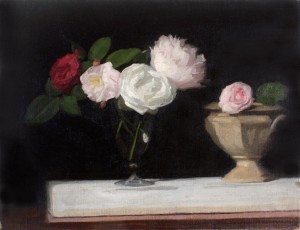
Yet to my eye his elemental compositions of fruit, bread and flowers set against dark backgrounds also owe something to later Spanish masters such as Diego Velázquez, Francisco Zurbarán, and especially Luis Melendez.
DuSold’s luminous oils combine the shimmering fluidity of the Venetian style with the classical rigor and slightly austere dignity realized in the Spanish approach. Martin Johnson Heade, a 19th-century American, also comes to mind.
Like the Spaniards, DuSold chooses simple, compact subjects – fruits and breads in containers, often set on a block of marble to create spatial variety, and accented with flowers.
Each grouping is a tiny universe of interacting objects held together by visual gravity. This effect is particularly apparent in a painting of a large cabbage and a small apple in a bowl, with an even smaller shell on a lower level.
The dark grounds not only create a spotlight effect, they encapsulate the brighter subjects in a cocoon of silence that isolates each group from the outside world. Ultimately, each picture becomes a finely calibrated demonstration of perfect equilibrium involving shape, light, color and texture – the basic tools of painting.