Palette Navigation Bar
Feed on
Posts
Comments

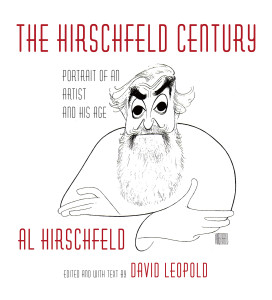
We have some good news and some bad news about our next show at the Studio of Ben Solowey. Let me start with the bad news. For only the second time in 23 years, we will not be opening a new show at the Studio in June. Unfortunately my work as a curator for museums around the country is to blame. Just last week I opened a big new show on Al Hirschfeld at the New York Historical Society titLeopold_jkt_r2led THE HIRSCHFELD CENTURY bringing together many of his greatest drawings under one roof for the first time. It coincides with the publication of my book of the same name by Alfred A. Knopf. It is probably the best thing I have ever written and while it is only available for sale for the first six weeks at the NY Historical Society, it will be in book stores everywhere (ok, Amazon, etc) on July 8th.
This week I head off to Chicago where I have been asked to assemble, in a very short time, an exhibition celebrating the Grateful Dead and their fans for the Field Museum to be on view when the band plays its final shows on July 3rd through 5th. The show will include not only lots of wonderful artifacts from the band and Deadheads, but it will be in fabulous Stanley Field Hall at the Field Museum which includes a dinosaur skeleton, stuffed elephants, and totem poles. In other words, it will be unlike anything I have ever done before.

Consequently, I can’t give the Studio show what it deserves and what our audience deserves, so rather than spread myself too thin, we are postponing the show until September.

And this is the good news actually. The show, Paper Trails by Ben Solowey, is an incredible collection of works of paper by Ben, many of which you have never seen before. There are several stunning drawings of Rae, including one of Ben’s first portraits of his wife who came to represent “woman eternal,” in so much of his work, along with very personal drawings of paintings of the Solowey farm in all of its seasons.

Of course, we will include some of Ben’s legendary Theatre Portraits, including one drawn from life of Arturo Toscanini that was exhibited only once before, ten years ago. There are works in charcoal, pencil, ink, pastel, watercolor, casein, etchings, woodcuts, and monotypes. Just when you think you have seen all that Ben has to offer, you will be surprised to discover works that will remind why Ben’s work continues to enthrall viewers.

In the Main Studio, there are oil paintings that have never been exhibited here, including his prize winning Pink Tablecloth, and even a selection of handcrafted frames by Ben that will be new to Studio visitors.

I apologize that my work denies many of you of your annual trek to Bucks County to revel in the world both in and outside of the Studio. I promise you that this new exhibition will be worth the wait. We will keep you up to date over the summer and share with you some of the pieces that will be included in the show in the fall. Remember it was the Philadelphia Inquirer that said, “When you visit the studio of Ben Solowey, you do more than see an exhibition, you enter an artist’s world…The charm of [the Studio] is its sense of intimacy and immediacy. Nothing is under glass or roped; rather, it conveys the uncanny feeling that Solowey has just stepped away from his easel and will be back any minute. On a crisp fall day, you couldn’t imagine wanting to be anywhere else.


We’ll see you when we do,

David Leopold
Director
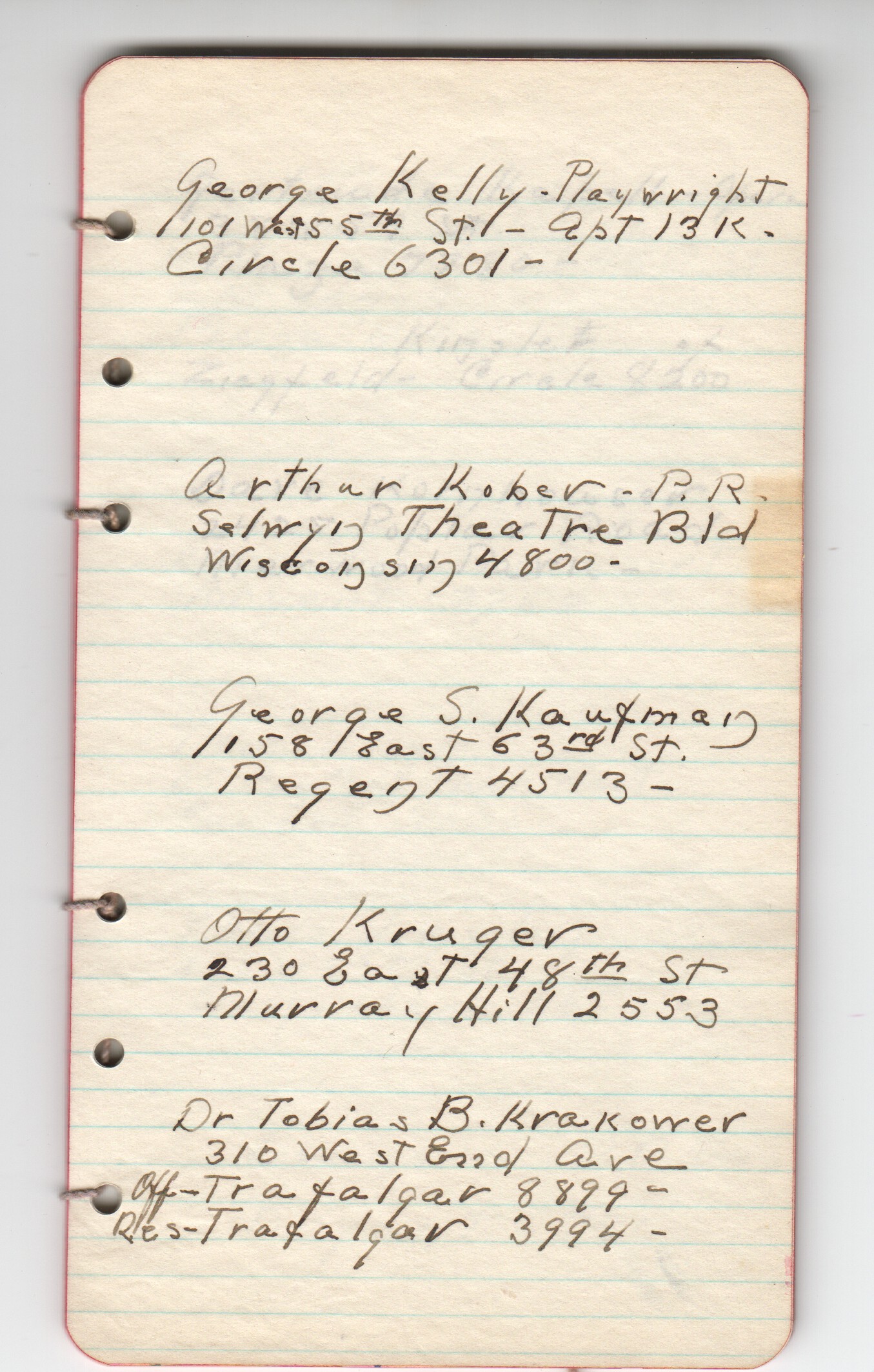
NYAddressBookHere is a page Ben Solowey’s address book when he lived in New York between 1928 and 1942, before moving permanently to Bucks County, Pennsylvania. This single page provides a glimpse into Ben’s world from that time.

The first entry on the page, obviously “K” in his address book, is playwright George Kelly. Ben had drawn a portrait of Kelly, a native Philadelphian who won the Pulitzer in 1925 for his play Craig’s Wife, in 1929 when Kelly’s play Maggie the Magnificent was about to open. Today Kelly is best known as the uncle of Grace Kelly, but his plays The Torch-Bearers (in which his niece Grace made her stage debut at the Bucks County Playhouse in 1949) and The Show-Off are still revived in theaters across the country.

Ben probably knew Arthur Kober, the second entry, strictly as press agent, who Ben would have dealt with to make appointments to draw performers. Kober had married playwright Lillian Hellman in 1925, although the union would not last. In 1926, he started to contribute humorous pieces to The New Yorker, and he became a regular contributor for next quarter century. He also wrote several plays and screenplays.

The third entry probably needs no introduction. George Kaufman was the both a popular playwright and director and New York Times drama editor when they met. Ben would draw Kaufman in 1941.

Otto Kruger was a character actor who Ben had drawn in a 1930 forgettable drama The Boundary Line. Kruger would alter go to Hollywood and often play villians such as Tobin in Hitchcock’s Saboteur (1942). In High Noon, ten years later, he played Judge Percy Metrick who tires to convince Gary Cooper to leave town before the gunfight.

The final entry on this page is for Ben’s dentist.

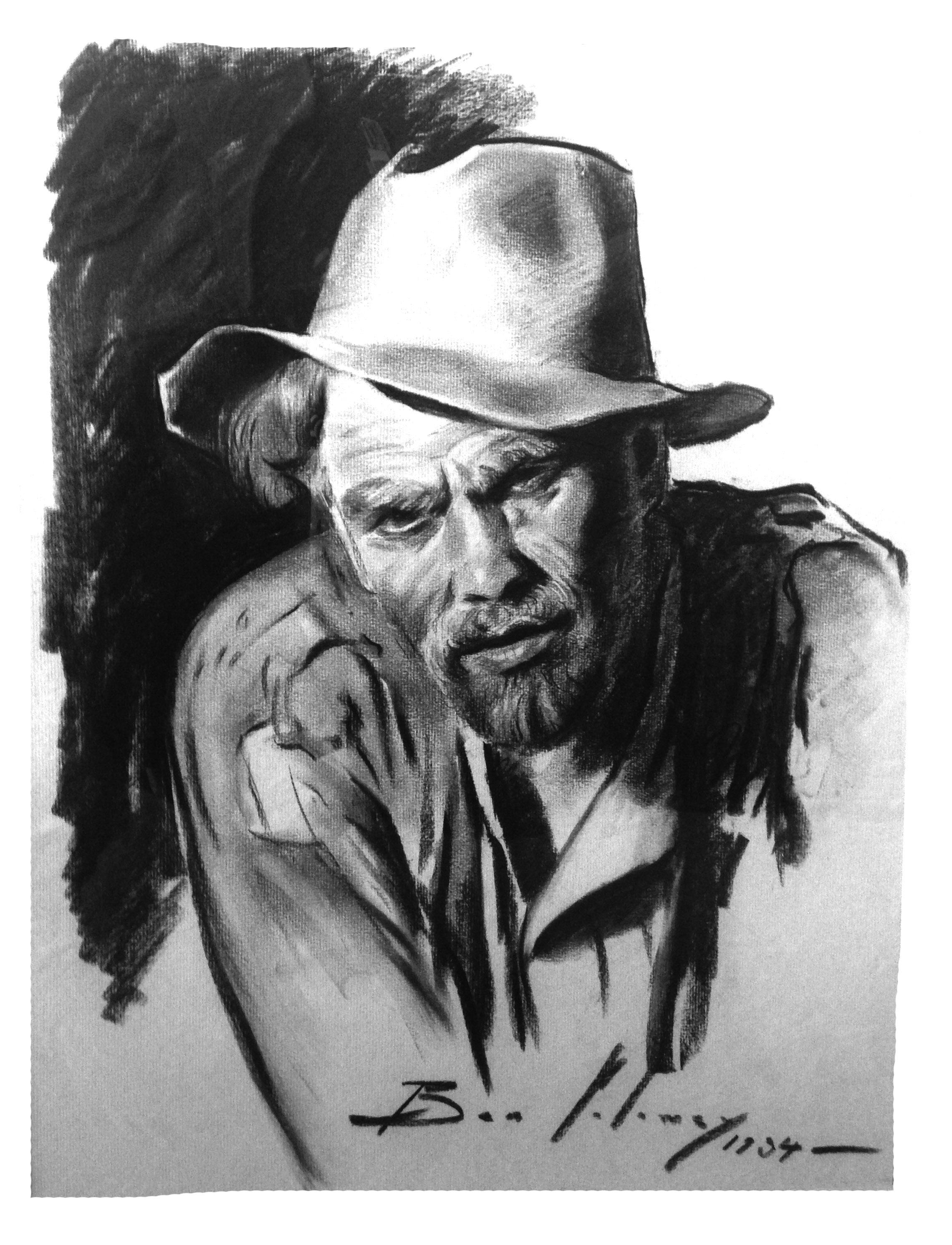
James BartonJames Barton was a song and dance man, famous for his drunk act. Early in his career, he frequently appeared in burlesques, and worked closely with African American dancers, eventually becoming a great eccentric dancer. The young Barton began his career at age 8, performing across the country with his parents who owned their own vaudeville repertory.

Barton’s first big break came when he was cast in The Passing Show of 1919 on Broadway, the Shubert’s response to the Ziegfeld Follies. This led to steady work for the next decade. Barton proved himself to be vaudeville royalty by headlining the Palace eight times from 1928 to 1932. In 1933, Barton turned to the legitimate stage with his career-defining role in the Broadway hit play Tobacco Road in 1933.

Ben drew Barton when he replaced Henry Hull as Jeeter Lester, the patriarch of the struggling Georgia family. Though disturbing and a sad portrait of a poor family, Tobacco Road was played more and more for laughs. With Barton’s background in comedic and often alcohol infused roles, he was able to bring a sense of likeability to the otherwise unlikeable Jeeter Lester. Over the course of 5 years, Barton played the role in over 2,000 performances, making it one of the longest running shows in Broadway history, as well as the 2nd longest running non-musical.. But Tobacco Road didn’t start out as a sure blockbuster.

From the first reviews of the Jack Kirkland play, it did not look like the Lester family would stay on Broadway for very long. Opening during the hard times of the Depression in December 1933, the story followed the Lester family of Georgia, who have hit hard times with the depletion of their tobacco crop.

Despite bad reviews, ticket sales took off when prices were cut from $3.30 to $1.10. Brooks Atkinson said of the play “Plays as clumsy and rudderless as ‘Tobacco Road’ seldom include so many scattered items that leave such a vivid impression.” The play was controversial, as it explored the principles of Eugenics, selective breeding and sterilization in humans. Ada, Jeeter’s wife, suffers from pellagra, a vitamin deficiency that causes dementia, among many other serious conditions. The couple’s daughter, Ellie May, has a harelip, and the family is unhealthily emaciated. The show was banned from traveling to many major cities, including Detroit and Chicago.

This long lasting hit would forever leave its mark on American popular culture. Henry Hull read a selection from Tobacco Road during the first television broadcast by RCA on July 7, 1936. Rae Solowey used to describe the farm in its earliest days as “Tobacco Road.”

Katherine Marshall
Associate Curator


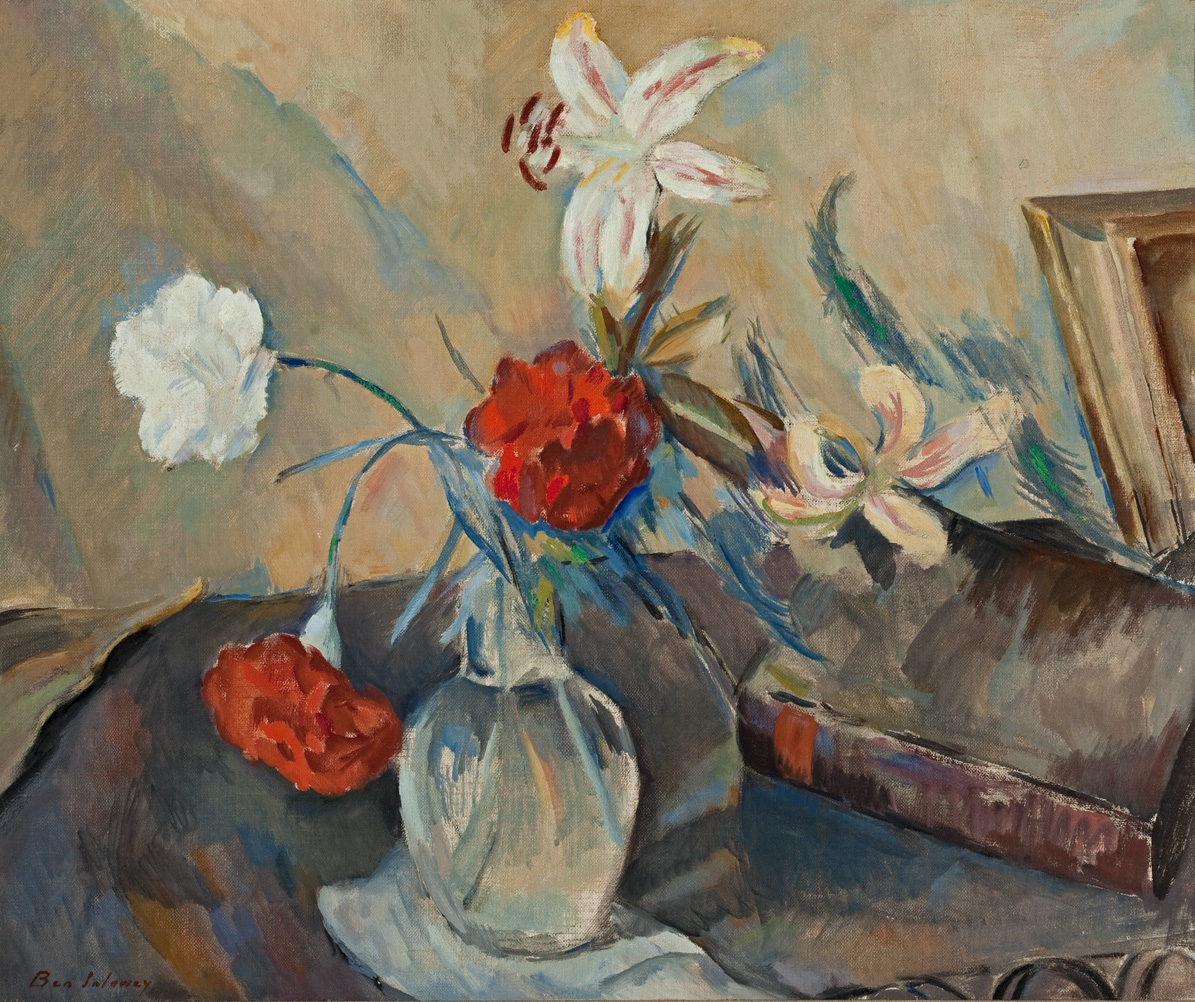
Carnations and Lilies Oil on canvas, 20 x 24 inches, 1930.

Carnations and Lilies
Oil on canvas, 20 x 24 inches, 1930.

When asked how she and Ben met, Rae wrote to her friend, writer Helen Papashvilly, “On April 5, 1930, I was having dinner with this person, a mutual Philadelphia friend of Ben’s, in the area of 72nd St. when he said ‘Let’s stop and see my friend Ben Solowey, the artist,’ which we did do, only to have no one show! Nothing daunted, as they say, a month later, in the same general area, same routine but – an answering bell from Ben (his studio on the 5th floor) and looking up from the ground one, through a maze of banister – there was Ben. In retrospect, and accustomed as I am to Ben’s present studio, in itself an art work, created, if you will, by him, the 72nd St. one was rather – unobtrusive, but on the easel, a jewel-like still life Carnation and Lilies. It has become part of me. As we were leaving, he asked if I’d have dinner with him the next night, but I was doing something else. The next night? The magic sesame – at dinner – he asked me to marry him, Said he would have done so the first night – except for this Person’s presence! Difficult not to invoke the ‘what if’ syndrome – had Ben been off his premises the second time – that just might have been that.”

Read the whole story of their meeting here.

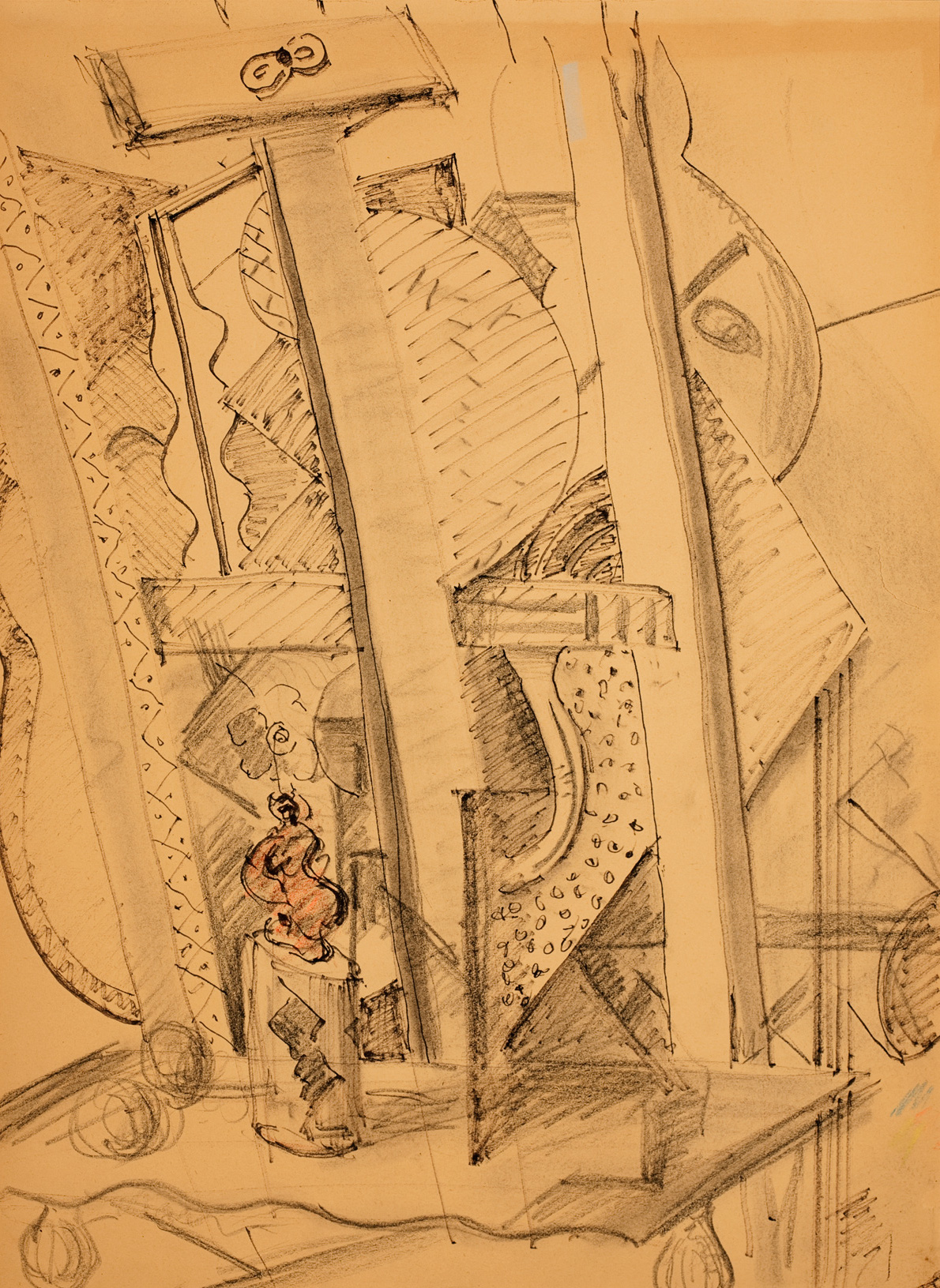
Abstract Composition Mixed media, 24 x 18 inches, c. 1949.

Abstract Composition
Mixed media, 24 x 18 inches, c. 1949.

This unusual work was inspired, at least according to Rae Solowey, by a landmark Matisse retrospective held at the Philadelphia Museum of Art in 1948. the exhibition had made a great impact on Ben and perhaps he saw how matisse evolved from traditional painting, in to a more modern abstract style. I doubt Ben ever considered not doing representational work, and indeed he thought many contemporary artists were “laughing up their sleeves” in their work because they could not draw. That was obviously not the case with Matisse, and perhaps that led Ben to want to experiment. He drew this work that shows the back of his easel using abstract shapes similar to the ones he had on rugs in the studio. Ben never exhibited this work and we’ve only exhibited this work twice over the years. First in 1997 in our Flights of Fancy exhibitions, and again in 2001 in our show on the modernist impulse in Ben’s work. Our still life show seemed like the right time to bring this experimental work out again after 13 years.

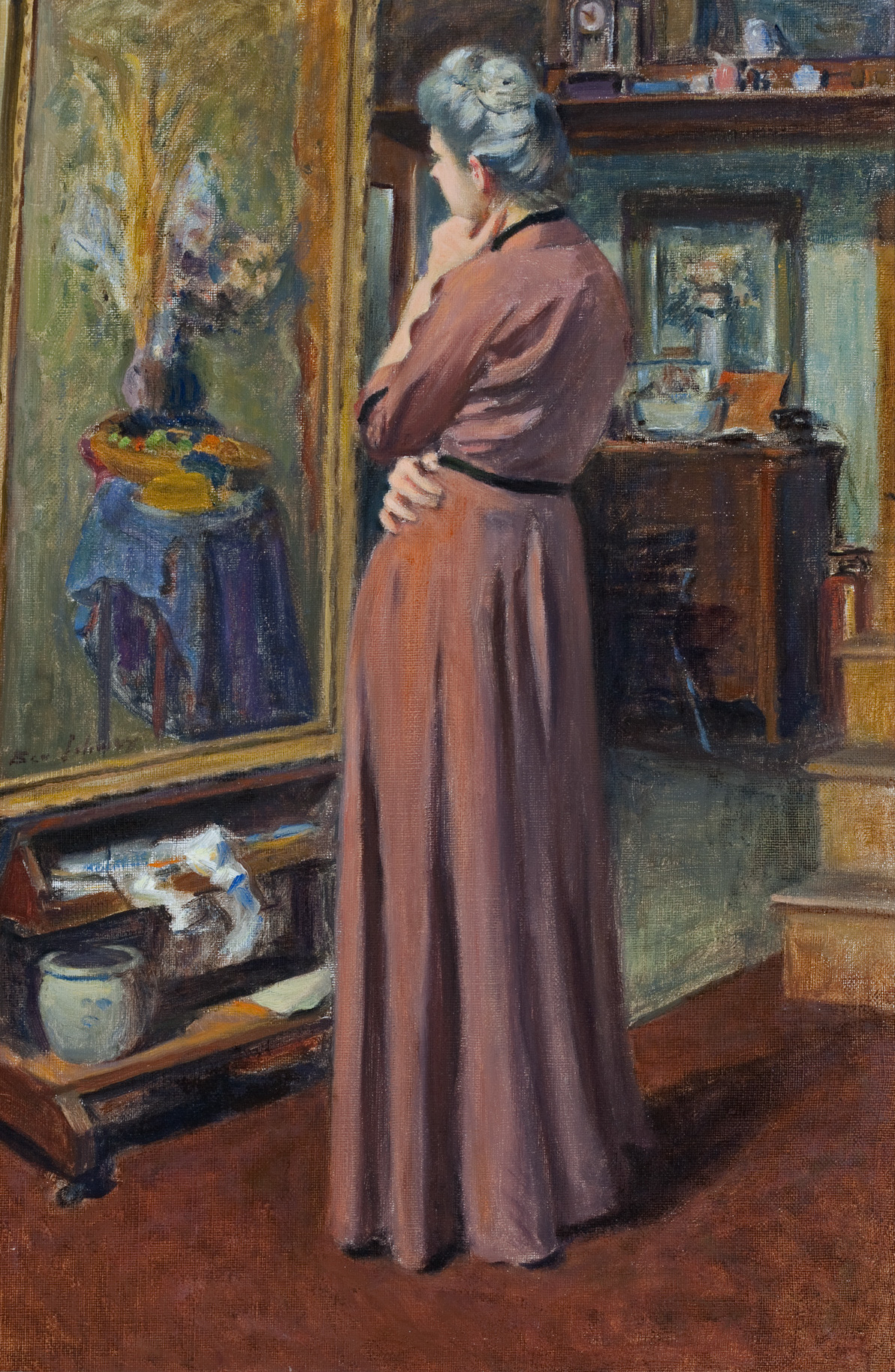
In the Studio Oil on canvas, 24 x 16 inches, 1963.

In the Studio
Oil on canvas, 24 x 16 inches, 1963.

I’m pretty lucky. I open exhibitions at museums around the country almost as much as most people open their refrigerator. Just last week I was in Huntsville, Alabama to open a new exhibition. This Studio show is my third of the year, and I will organize or re-organize two more shows before the year’s out.

Some may think that would make me jaded, but truth be told, I’m still am very excited when a show opens. Taking an idea and making it a reality is wonderful. Sharing it with an interested audience is even better. Literally, you are the reason I spend the time on exhibitions.

This year, I am even more excited than usual about our new show on still lifes. Not only is it a wonderful show (biased as I am), but the catalogue will let us all see it long after the works come down off the wall. I often joke I am in the mirage business because I work for a long time, often years, on an exhibition and it comes together and looks terrific and then within 12 weeks usually, there is no sign it ever happened. Publications are the way curators and visitors can hold onto an element of the show, and of course add to the scholarship of the subject. 

While it may not be nearly as interesting, I am glad we are finally providing an easy place to park no matter what the weather. We have struggled with this issue for years, as we decided early on that we did not want to “institutionalize” the Studio and rob it of its intimate charm. That is why we have no traditional gift shop or tea room, or velvet ropes or glass cases, for that matter. When you come to the Studio of Ben Solowey, you get exactly what is advertised: the Solowey Studio more or less as Ben had it. Not as a mausoleum, but as an ever changing atmosphere just as it was when Ben Was working. The parking area, now allows us to do more at the Studio all year round, instead of simply in June and October. Now you can bring your motorcycle, Mercedes or moped any time during the year, rain or shine, and know that it will be as easy to get out as it was to get in.

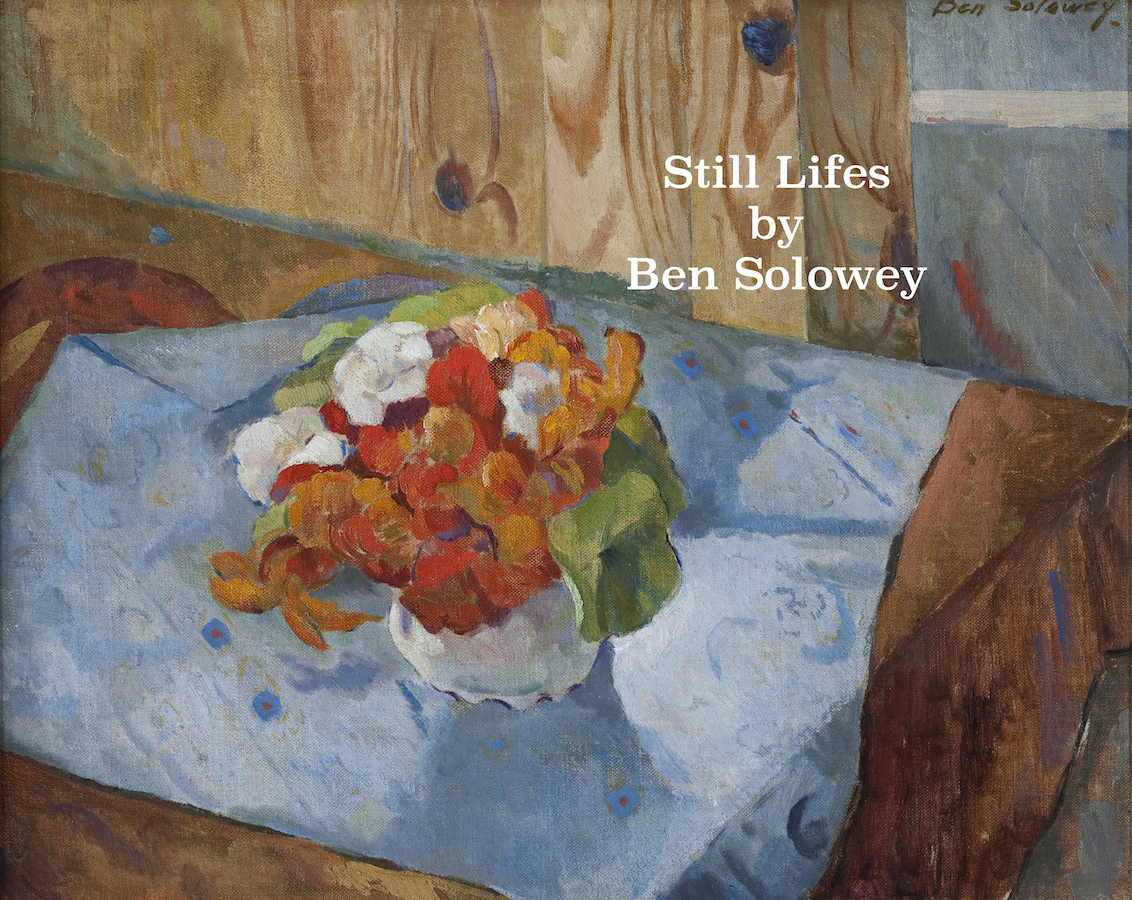
still life cover v2 lowresWe are also proud to announce that on June 7th when we open our new exhibition, Still Lifes by Ben Solowey, we will have a limited edition catalogue featuring most of the works in the show. This handsome 11 × 8.5 inches, 20-page publication will be $30, and will only be available during the run of this exhibition.

To pre-order contact info@solowey.com or 215-795-0228.

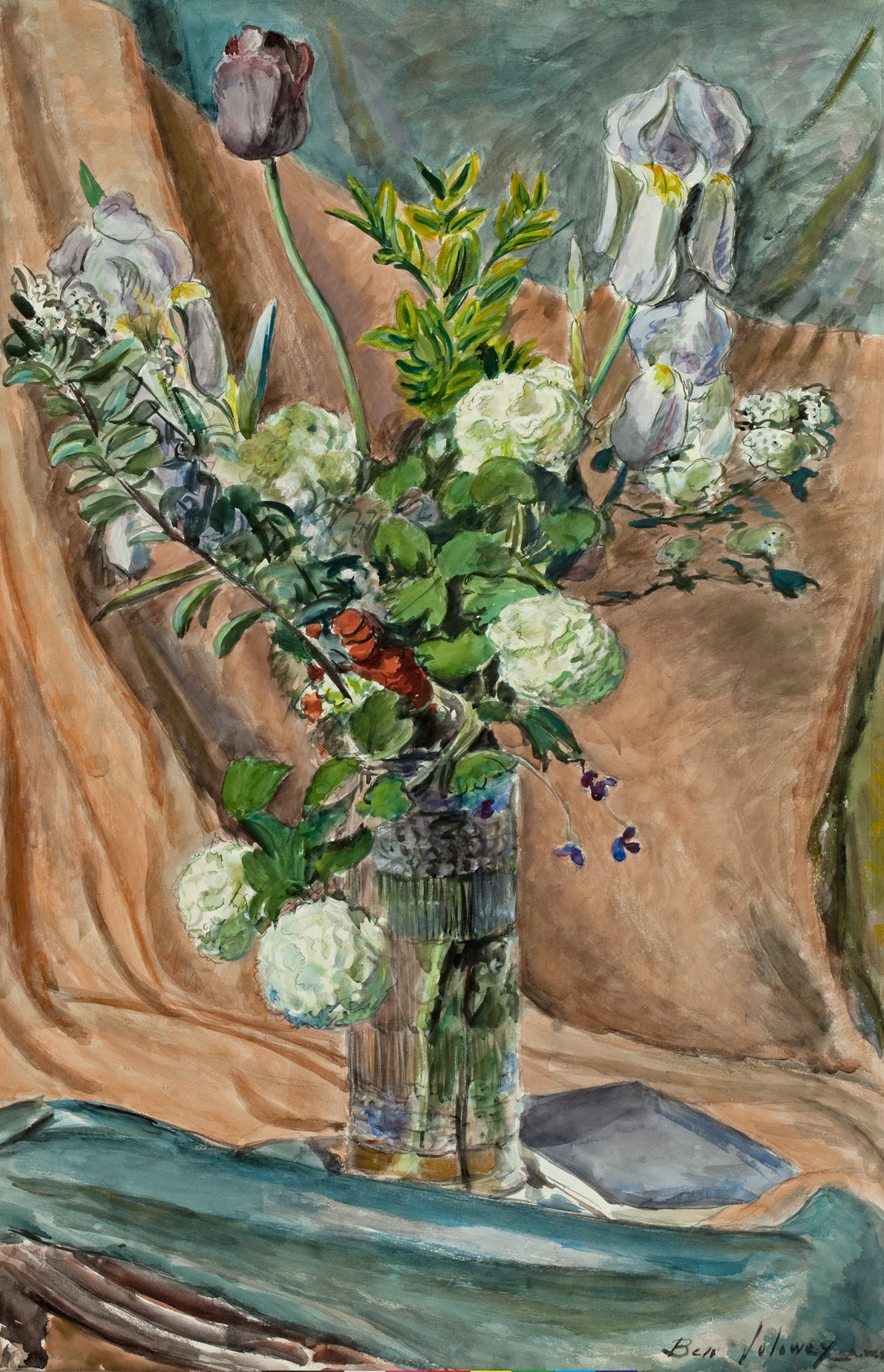
687To be organizing a show on Solowey Still Lifes in the spring, as the flowers seen in many paintings are just starting to bloom is a fascinating experience. We can know practically the month and day he painted works like Iris & Snowballs (seen at left), because those same blooms are on view right now. Of course by the time of our opening on June 7th, Ben’s favorite flower, the peony, will be in bloom, and visitors will see his garden ringed with them.

I am very excited to have a catalogue of nearly 20 works in our new exhibition. When we started 21 years ago, it would be hard to imagine a small run of a full color publication. People have long asked to have some memento of our shows, we  hope this will become a regular feature of our shows. 

Look for information on particular works in the exhibition on The Letter blog on our website. While we don’t use too much text on our walls, as anyone who has been here or knows me, there is always plenty to tell about individual works.

Something that is already a regular feature of our openings is the home baked goods that fill the Solowey home. This tradition was started by my mother Joan Leopold, but was also a hallmark of Rae Solowey’s. Rae made a mean chocolate cake and even Ben was heralded for his cherry pie. At times, I have been convinced that people come to the openings for the goodies and enjoy seeing the art as well. We have featured some recipes over the years on our website, but now many of my mother’s recipes for desserts as well as every other part of the meal have been collected in the “Cooking For a Cure” cookbook that has recently been published to raise funds for Lungevity (in memory of Joan Leopold and Ann Leopold Kaplan) and Relay for Life (in memory of Susan Lench). Copies are only $10 and will be available during the run of the exhibition. 

Consider yourselves the first to know that my Tony Auth retrospective will be on view at The Philadelphia Foundation this fall. Opening on September 10, the exhibition kicks off the campaign to bring Tony’s remarkable intact archive of art, prints and related ephemera to Temple University. Nearly 100,000 people have seen this show already, so if you have not seen it, please make a point to get into Philadelphia this fall to see at The Philadelphia Foundation’s Market Street headquarters.

We’ll see you when we do,

David Leopold

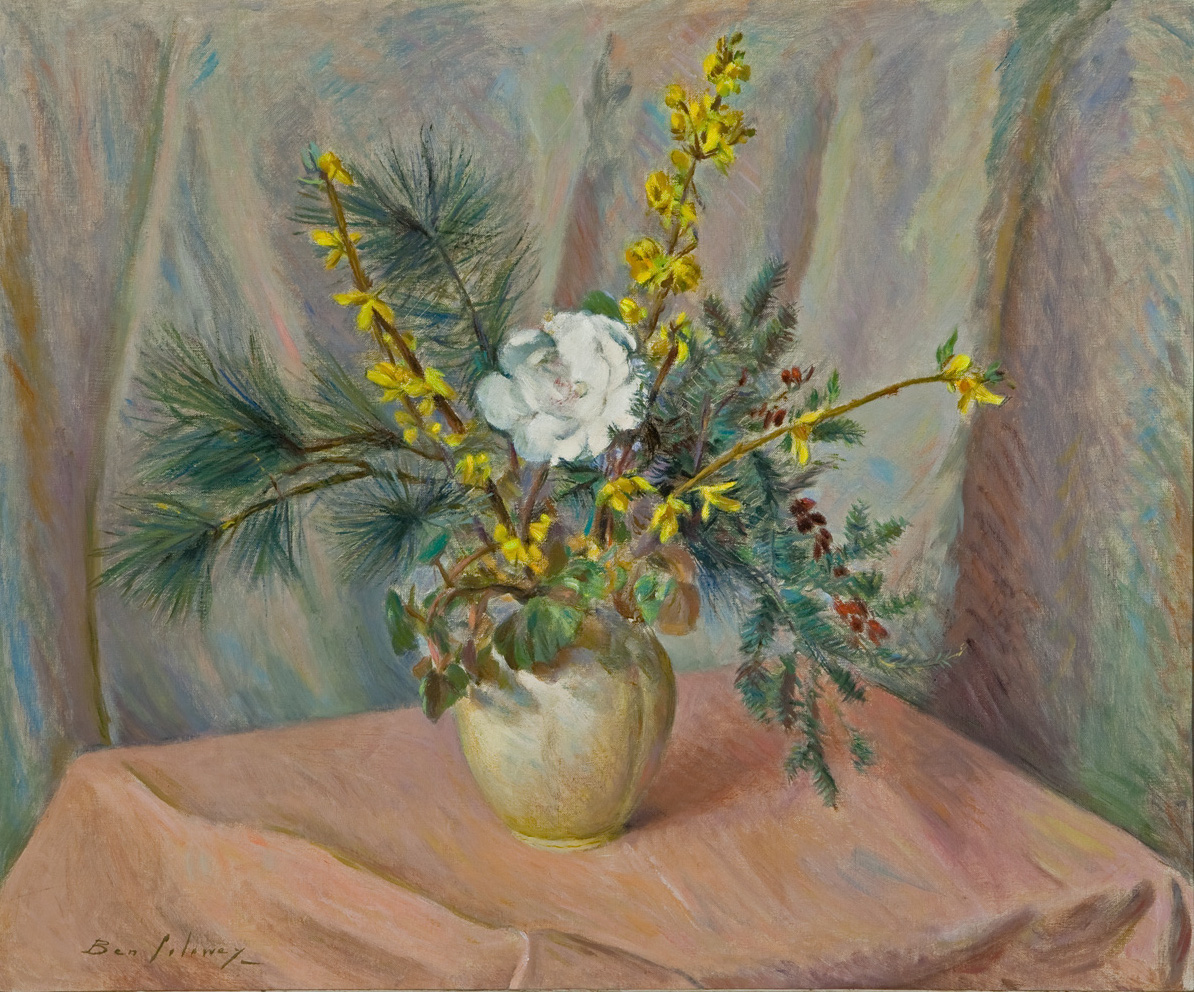
White Gardenia and Pine Needles14
Oil on canvas
25 x 30 inches, 1948

Rae Solowey once said that every time Ben looked out a window of his studio, he saw a new landscape to paint. He might have said the same thing about still lifes. For most of the 36 years Ben called the farm home, he grew flowers which he used in his painting. He rarely painted any still lifes in the winter with purchased flowers, although he did paint dried flowers from his garden.

When I look at this still life from 1948, I envision an artist anxious to paint his first still life of the season. He took the spring’s earliest bloom, the forsythia, and the ever present (and ever green) pine to make an early spring still life. The gardenia? That alas is cloth imitator, a fake flower that he employed to balance his picture. We still have all the elements of this picture here at the Studio of Ben Solowey. The forsythia, which at one time lined the creek the runs through the property is now down to one large bush. The pine trees that Ben planted still tower over the property. The gardenia, vase, and cloth are all still part of our collection here. Yet it is the sum of these things as transmuted by Ben into a beautiful work that feels as fresh today as any new bloom.

From the Director

After last summer’s opening, I returned to work on four different shows that all opened in October 2013 in three different cities. As many of you know I work as an independent curator for museums around the country and in Europe, and last year turned into a “perfect storm” of wonderful opportunities that I could not say no to (although I should have.)
 
My very popular retrospective on the work of editorial cartoonist, Tony Auth, first organized for the James A. Michener Art Museum in Doylestown, Pennsylvania, traveled to public radio’s WHYY, where Tony now works. It was the first time they had ever hosted an exhibition and it turned out to be a popular event for the station and its supporters. A few blocks away at the Philadelphia History Museum, I put together a 50 piece show of Tony’s cartoons on the City of Brotherly Love, titled AUTH-entic Philly, which proved so popular that it was held over for three months. 
 
In New York, I organized The Line King’s Library: Al Hirschfeld at the New York Public Library for the Performing Arts Library at Lincoln Center. That show turned out to be a big hit with many visitors and lots of great press, including a wonderful writeup from the venerable Art News.
My final show of the month was an exciting challenge to tell the inherently dramatic story of the Bucks County Playhouse for a special exhibition celebrating the 75th anniversary of one of the country’s most important summer theaters. paired with a big show on Grace Kelly (who got her start at the Playhouse), the exhibition was seen by nearly 100,000 visitors. if you were among the few who missed it, a 25 minute film of the exhibition featuring interviews with a variety of folks connected with it, and hosted by yours truly will be available June 30th, along with an accompanying 40-page book which will include many of the highlights of the show. 
Besides doing press for these shows, I organized a reading of scenes from plays that told the story of the Playhouse for a special event at the Michener in December, put together two other shows for Syracuse University and the Huntsville (Alabama) Museum of Art and have signed on to do two books for next year, and another for 2016. 
Along the way I found time to put together a show many have asked for over the years: an exhibition of Solowey still lifes. There are works from every part of his career and looking at them already on the wall, biased as I am, they are stunning. As much as I love the bold modernist still lifes of the 20’s and 30’s, I must admit I am partial to the works composed of flowers that were grown here on the farm, many of which still bloom, whether they be peonies, hydrangea, tulips, lilies, forsythia and daffodils. As I have been doing research on the history of still life painting, which frequently included objects to denote mortality or the passing of time, Ben’s seem quite different. They are more about life than death. A celebration of the bounty from the earth. I often remember Rae reciting John Greenleaf Whittier:

“If thou of fortune be bereft,
and in thy store there be but left
two loaves, sell one, and with the
dole, buy hyacinths to feed thy soul.”

For Ben and Rae, a floral arrangement on the dining room table was as important to them as the food on their plates. You’ll understand why when you see this show.
For those of you who voted for the Michener’s top 25 artworks exhibitions to

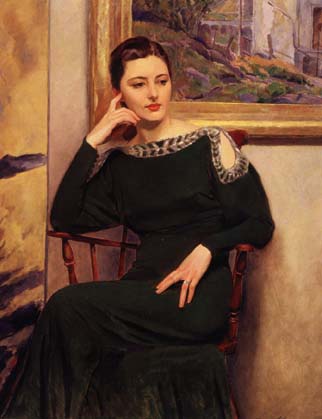
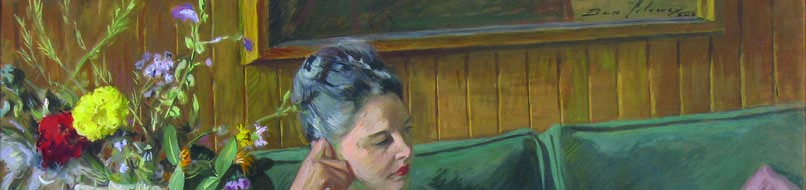
Rae Seated (Green Dress)

Rae Seated (Green Dress)

celebrate their silver anniversary. Rae Seated (Green Dress) placed in the top ten and had a remarkable set of comments written by visitors. I share those with you soon.

We are looking forward to seeing you soon. Look in your mailbox for an invitation


« Newer Posts - Older Posts »